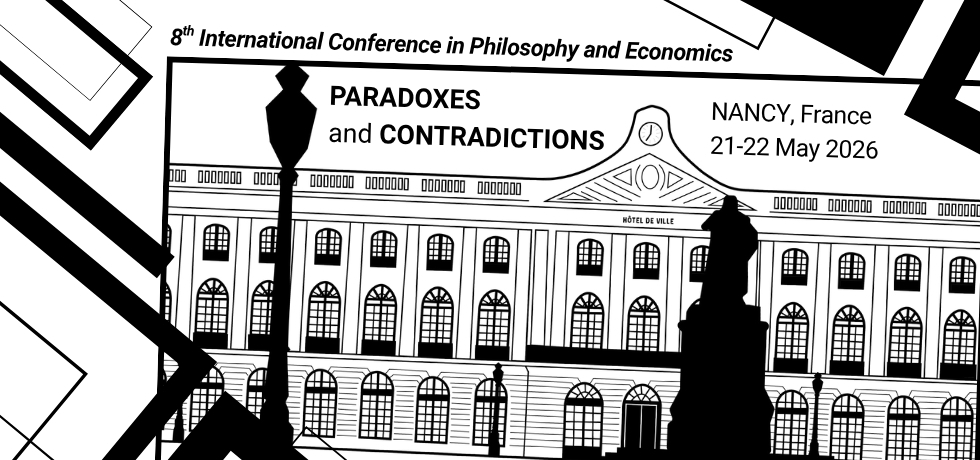
Young Scholars Workshop > Call for papers
Professors Roberto Fumagalli (King’s College London) and Magdalena Małecka (University of Copenhagen) will join the event as invited lecturers and discussants, engaging with the young scholar presentations and the subsequent discussions.
Call for Papers:
“Conflicts and Tensions in the History and Philosophy of Economics”
20 May 2026, Nancy, France
How conflicts and tensions have shaped and structured economic thought and the philosophy of economics since the early 19th century? Conflicts often emerge when the coherence of economic concepts is critically examined. We examine these concepts either internally, regarding their logical consistency within theoretical systems, or externally, in relation to their correspondence with other frameworks or observed economic and social phenomena. This way, tensions and conflicts reveal the limits of conceptual frameworks, while they actively drive the evolution of the discipline. They generate critical insights, inspire reflective approaches, and open avenues for new theoretical and normative perspectives.
Tensions and conflicts have arguably structured economic thought from classical to contemporary economics. They draw upon a great variety of sources, ranging from theoretical models and empirical realities, logical consistency and normative evaluation, to deeper methodological and epistemological concerns. Contributions on historical and contextual conflicts or on tensions such as the disagreements between authors, debates within or across “schools” of thought, or competing economic paradigms are encouraged. Papers may also evaluate the epistemic significance of a particular conflict or tension. Research may also focus on identifying a central conflict within or across different works in economics, pointing out transversal conceptual limitations, pointing out paths for innovation, or proposing ways to overcome enduring conflicts in economic thought. Works that contribute to a more objective assessment of economic thought are also welcome.
The conference committee welcomes submissions exploring how conflicts and tensions can shed light on the methodological coherence and legitimacy of economic approaches from historical and philosophical perspectives, while remaining open to the widest range of topics within economic philosophy. Young scholars are encouraged not only to analyze controversies in the history of classical or modern economic thought but also to propose any reflective approaches or discussions at the intersection of economics and philosophy.
The aim of this YSI session is to create a stimulating intellectual environment for young scholars, fostering critical reflection on economic thought. Indicative questions of interest include: How can historical tensions and conceptual conflicts reveal the originality or contemporary relevance of economic ideas? To what extent do conceptual conflicts, inconsistencies, or dead ends influence the evaluation or continuation of an author’s work? What role have conflicts and tensions played in economic practices across historical periods? How can innovative approaches or reflective solutions help resolve or transcend these conflicts? Is there still room for the development of genuinely new concepts to address enduring tensions?
Submission Guidelines:
-
Word limit: 1000 words
-
Language: English
-
Submission deadline: 31 January 2026
-
Notification of acceptance: 16 February 2026
-
Full papers due: 20 April 2026
Link to applications/submissions: https://forms.gle/4KGx8QXWvsue84BF7
For any inquiries, please contact us at: dn.demirel@unistra.fr
Organising committee:
Julie Audureau (BETA, Université de Strasbourg)
Deniz Demirel (BETA, Université de Strasbourg)
Arnaud Niedbalec (PRISM, Université Paris 1 – Panthéon-Sorbonne)
Daniel Zarama Rojas (BETA, Université de Lorraine)
This workshop is supported and co-organised by YSI–INET and BETA.